Embedding SEL in Inclusive Music Classrooms
Embedding SEL in Inclusive Music Classrooms
Why this matters
Music class is already a social lab: risk, feedback, public performance. When students carry anxiety, sensory overload, or regulation hurdles, “just focus” is not a plan. Embedding social-emotional learning (SEL) inside instruction supports self-regulation and belonging while you protect musical rigor. Pair SEL with Universal Design for Learning (UDL) so access is designed in, not stapled on. CAST’s July 2024 UDL Guidelines 3.0 push us to remove systemic barriers and honor learner variability. UDL Guidelines
Core idea
Don’t fix the student; fix the design. Design multiple ways to enter tasks, rehearse safely, and show learning, then teach behavior like any other ensemble skill. ArtsEdSEL and Save The Music’s program documents how SEL embedded in music boosts identity, belonging and agency. Save The Music Foundation+1
Step-by-step strategies
1) Two-path warm-ups to lower the “start” friction
Post an entrance board with two equivalently rigorous warm-ups that hit the same target. Example for winds:
Path A: drone-supported long tones with crescendo/decrescendo;
Path B: lip-slur ladder with metronome.
Choice increases autonomy and on-task behavior without changing your musical goal. UDL calls this offering multiple means of action and expression. CAST
2) Micro SEL prompts that don’t eat your class time
Between warm-ups and lit, insert a 20–30 second prompt:
“Name one section strength, one growth target.”
“What emotion showed up when tempo increased?”
Brief reflection normalizes challenge and gives you fast formative data to adjust pacing.
3) Rotating peer roles that widen participation
Assign roles that keep reluctant players engaged:
Empathy Captain checks on a peer who hesitates.
Calm Cue Leader initiates a 20-second breath/stretch reset when requested.
Reflector closes rehearsal with one strength/one growth from the group.
Roles embed SEL into the musical task flow and increase equitable participation. Arts Ed NJ
4) “Stress inoculation” for the hardest passages
For that cursed measure 47:
Silent rehearsal: air-play or finger without sound.
15-second breath reset.
Two short reps at success tempo, then one at performance tempo.
Name the feeling that spiked, plus the cue that calmed it.
Students build tolerance for performance stress while you improve accuracy.
5) Teach behavior like content using PBIS tools
Classwide PBIS routines and CW-FIT have increased on-task behavior and improved teacher praise-to-reprimand ratios in music settings. Teach “Rehearsal Ready” as a skill, then use brief group contingencies and frequent, behavior-specific praise. Even outside formal CW-FIT, higher praise-to-reprimand ratios correlate with better on-task behavior. SAGE Journals+2SAGE Journals+2
6) Materials that remove barriers without dumbing down
Offer a second “view” of the hardest spots: larger font, boxed phrases, fingerings/solfege, or simplified rhythms that keep the musical target intact. That’s UDL: flexible methods, fixed goals. CAST
7) Assessment menus, constant criteria
Keep criteria stable (tone, rhythm, phrasing, ensemble awareness) while offering options: record a phrase, annotate a score image, conduct a section, or submit a concise practice reflection. UDL supports varied outputs toward shared objectives. CAST
Primary vs secondary adaptations
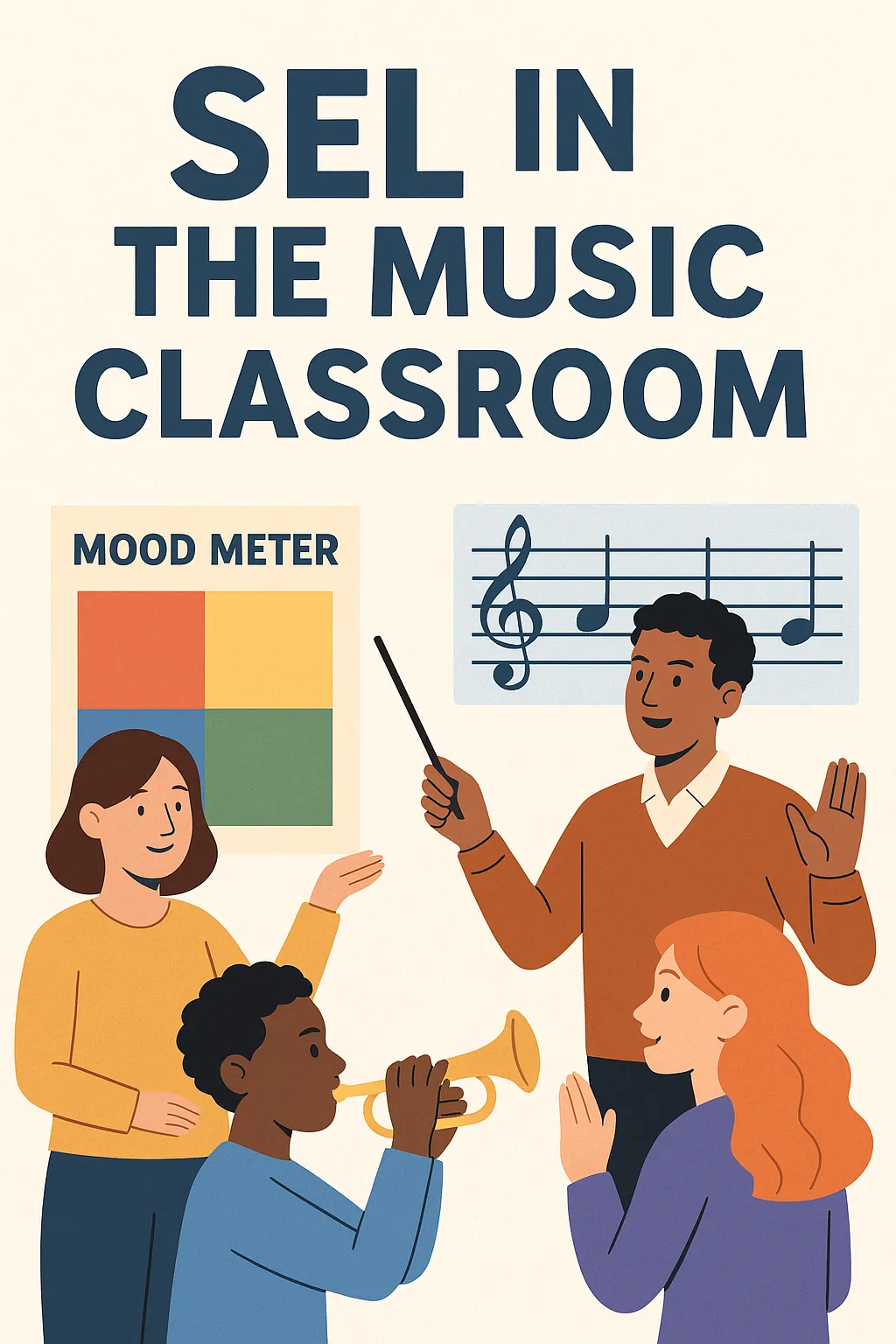
Primary: pictorial Mood Meter; one prompt per class; embed in singing games and movement.
Secondary: metacognitive prompts; rotating roles weekly; short journaling linked to specific measures.
Classroom vignette
In 7th-grade band, two students regularly froze during cut time. The director added a Mood Meter at entry, a 20-second “strength/growth” checkpoint, and a Calm Cue Leader. After two days, the section’s starts stabilized. Students named “rushed breathing” as the trigger; the fix was three slow counts before entries. Musical outcome improved because emotions got handled inside the rehearsal, not after.
“Try This Tomorrow” checklist
Post two warm-up paths toward one goal
Teach “Rehearsal Ready” and praise the first section to hit it
Insert one 30-second strength/growth prompt
Assign Reflector for closure
Create an alternate “view” for the hardest 8 bars
